 ☰
☰
One Question a Day: A Simple Habit That Reveals How Your Child Thinks

Published By
Tushar Sinha
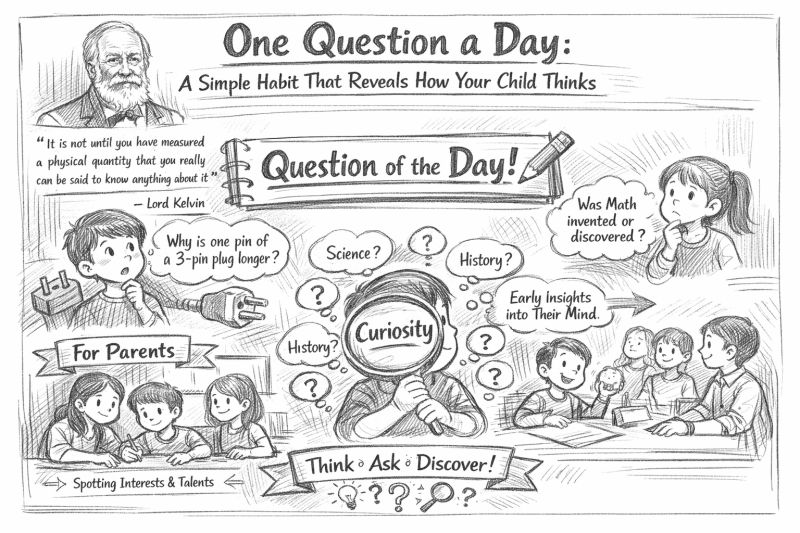
“It is not until you have measured a physical quantity that you really can be said to know anything about it.”
— Lord Kelvin
This idea lies at the heart of scientific thinking: observe, question, reflect, and then conclude.
At Centum, we are attempting something simple yet powerful — applying the scientific method to understanding how students think, learn, and discover their interests.
Introducing the “Question of the Day” (QOTD)
As part of our Activity Sheet–based reflective practice, we are introducing a daily habit for students:
Question of the Day
Every day, students are encouraged to write one original question —
not copied from textbooks, homework, or the internet, but arising from genuine curiosity.
Some examples of questions students naturally ask include:
-
Why is one pin of a 3-pin plug longer than the others?
-
Was mathematics invented or discovered?
-
What would happen if the Earth suddenly stopped rotating?
-
Why are there 12 months in a year and not 10 or even 100?
Finding the answer is optional.Learning to ask the question is essential.
Why Question-Asking Matters More Than Answers
In traditional learning environments, students are often rewarded for answers.
However, deep learning begins with the quality of questions.
The purpose of the Question of the Day is not to test knowledge, but to:
-
Encourage original thinking
-
Develop intellectual curiosity
-
Build comfort with uncertainty and exploration
-
Help students observe the world more deeply
Over time, this simple habit nurtures independent thinkers rather than passive learners.
A Powerful Lens for Parents
The nature of questions children ask offers remarkable insight into their natural inclinations and interests.
Patterns often emerge quickly:
-
Children who repeatedly ask “why things work” may show an inclination toward science or engineering
-
Questions involving numbers, patterns, and logic often reflect mathematical thinking
-
Curiosity about society, people, or the past may indicate interest in humanities or social sciences
-
“What if” and imaginative questions often signal creative or design-oriented thinking
These patterns are not accidental.
What Research and Educators Observe
Educational psychology research consistently shows that early patterns of curiosity strongly correlate with later academic interests and career inclinations.
Long-term studies in child development highlight that question-asking behavior is one of the earliest indicators of intrinsic motivation and domain-specific interest.
In classrooms and mentoring environments, educators have repeatedly observed that students who maintain a question journal often:
-
Identify their interests earlier
-
Show higher engagement in learning
-
Develop stronger critical thinking skills
-
Gain clarity about subject preferences well before formal choices are required
How the Activity Works
-
Each day, your child writes one question they genuinely want to explore
-
The question should arise from:
-
Daily observations
-
Personal experiences
-
Thoughts, doubts, or curiosities
-
Writing an answer is optional
-
Copying from textbooks, homework, or online sources is strongly discouraged
The goal is to let curiosity flow naturally, without fear of being right or wrong.
Let Curiosity Lead the Way
We encourage parents to allow this process to unfold organically.
Avoid correcting, judging, or immediately supplying answers.
Instead, observe.
Let the Question of the Day (QOTD) become a quiet yet powerful part of your child’s learning routine — and notice how their thinking, confidence, and curiosity evolve over just a few weeks.
Sometimes, the most important learning begins not with an answer, but with a well-asked question.

Recent Posts


Start Your Success Journey